Commercial kitchen and warehouse pest defense fits facilities where health inspection compliance, supply chain cleanliness, and structural protection are non-negotiable operational requirements. In high-output culinary…
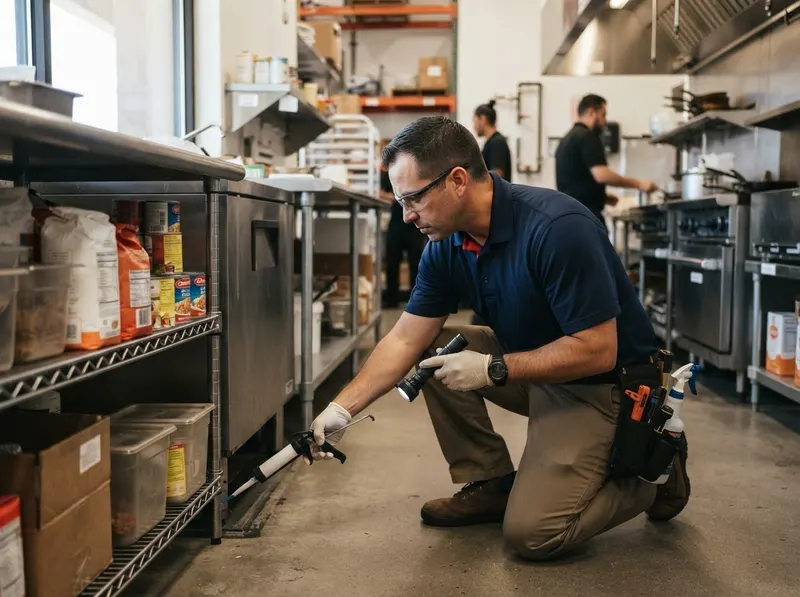
Commercial kitchen and warehouse pest defense fits facilities where health inspection compliance, supply chain cleanliness, and structural protection are non-negotiable operational requirements. In high-output culinary spaces like restaurant hubs in the Biltmore Area, Arcadia, and Downtown Phoenix, food debris and hot wash-down water create grease deposits inside drain lines where American and German cockroaches thrive. Warehouse corridors across Maryvale and North Mountain Village face a separate vulnerability: constant truck turnover through dock levelers leaves gap spaces where roof rats enter to escape ambient valley heat. Standard monthly spray programs fail in these environments because standard pyrethroids degrade rapidly under 110-degree dock aprons and wet scullery floors. An integrated commercial barrier instead combines non-repellent insect growth regulators (IGRs), targeted microencapsulated baits placed away from food prep counters, and heavy-duty silicone foam exclusion around electrical conduit entries.
The clear operational trade-off centers on upfront mechanical remediation versus ongoing reactive chemical applications. Correcting physical access points, such as installing 0.25-inch steel-mesh dock sweep gaskets and sealing floor expansions, carries higher initial site labor, yet it halts inventory losses from gnawed packaging and prevents immediate health department demerits. For distribution operations in Desert Ridge or logistics centers near Encanto Village and Ahwatukee Foothills, warehouse storage holds distinct challenges: high-bay pallet racking provides extensive harborage for roof rats navigating overhead ceiling trusses. A facility must decide whether to deploy a localized trap-and-monitor grid or complete perimeter reinforcement; perimeter fortification protects bulk inventory across thousands of square feet, while localized monitoring simply documents population movement after interior penetration has already taken place.
Treatment execution follows a clinical 4-step sequence: 1. Full floor and perimeter diagnostic mapping checks moist scullery junctions, refrigeration motor pans, and dock plate corners. 2. Non-volatile bait gel arrays and biological enzyme foam applications eliminate active breeding colonies inside floor sinks and grease trap voids without airborne drift. 3. Exterior perimeters receive high-temperature microencapsulated residual barriers rated to withstand continuous desert ground temperatures exceeding 140 degrees. 4. Tamper-resistant bait blocks are mapped and dated inside secured steel-anchored exterior stations. Facilities receive complete documentation aligned with Maricopa County Environmental Services Department standards to satisfy third-party food safety audits.
Every job gets a firm, written price after a free on-site visit.
Tell us about your commercial kitchen and warehouse pest defense job in Phoenix and we'll send a clear, written quote, usually the same day.
 Blue Barrel Pest Control